

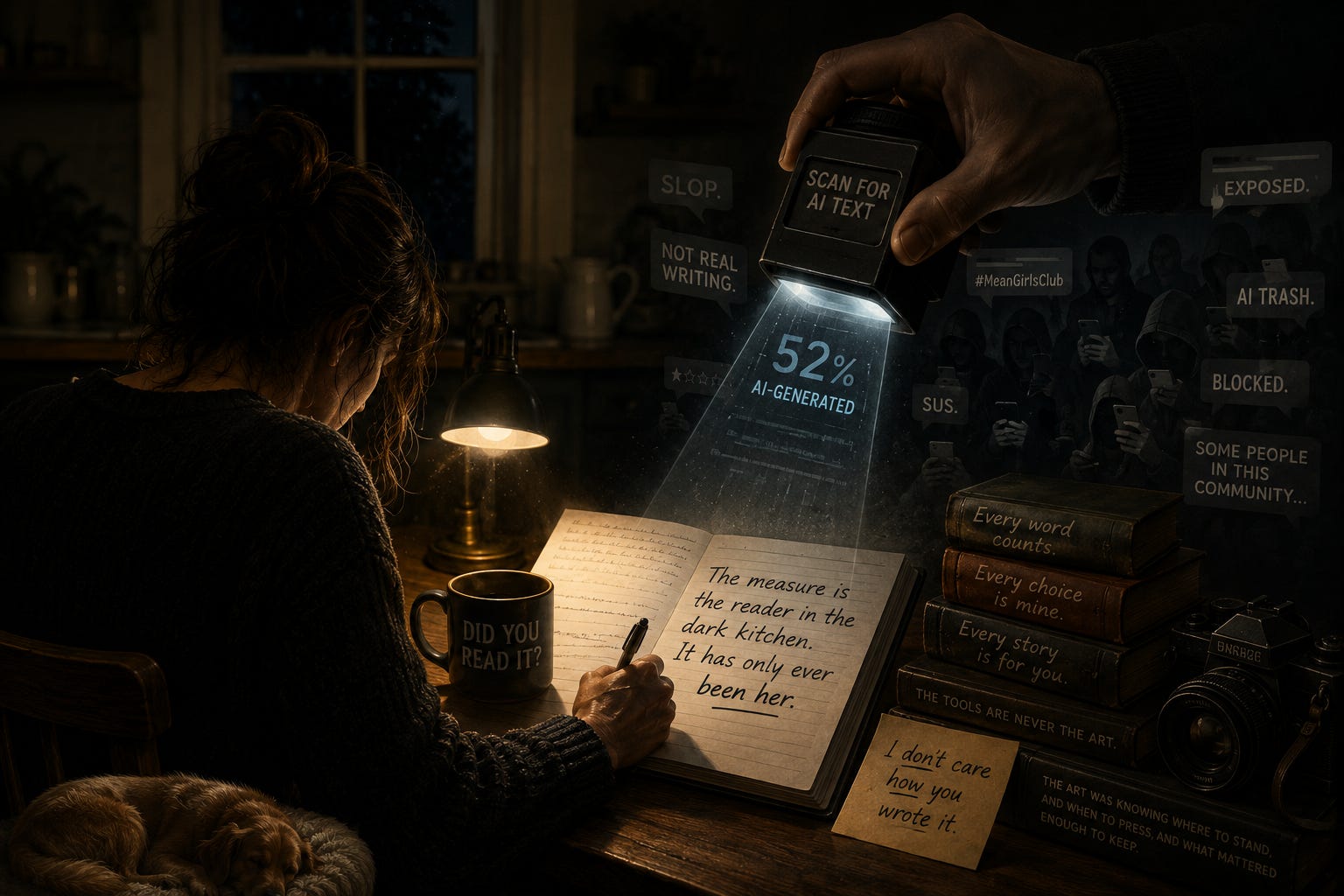
I don’t care how you wrote it.
I want to say that as plainly as the language allows, because everything else I’m about to say stands on it. If your story reached me — if I looked up from the page and the kitchen had gone dark around me and the dogs needed feeding an hour ago — then you wrote a story, and it worked, and that is the entire transaction. I don’t care if you bled it out longhand at 4 AM or talked it into your phone or built it with every tool available to a working writer in 2026. I have never once finished a book that wrecked me and thought, but first, let’s audit the workflow.
I have never met that reader. I’m not convinced she exists. Which brings me to the button.
On July 21, Substack partnered with Pangram, an AI-detection company, and gave every reader a new option on every post, note, comment, and reply over a hundred words: “Scan for AI text.” Press it and receive a percentage — an estimate of how much of a writer’s words were made by hand and how much with AI assistance. The stated reasoning: people should know what they’re getting.
But people already knew what they were getting: They were getting the writing. It was right there — every sentence available for the oldest quality test in the world, the one where you read it and it either lives or it doesn’t. What the button offers isn’t knowledge about the work: It’s a verdict about the writer.
And I want to ask the question the launch announcement never asks:
Who presses it?
Not the reader who loves a writer, because she’s not scanning; she’s reading. Something in the work reached through the screen and touched her actual life, and no percentage will un-touch it. The delighted reader, the moved reader, the reader up too late with one more chapter — that reader has no use for this button and will never open it.
The button exists for a different reader.
The reader who already suspects or is suspicious. Who’s spent months in the notes calling strangers’ work “slop.” Who keeps lists: announcing her blocks like press releases, diagnosing writers she’s never read, and calling the whole practice discernment. I’ve been documenting this reader for a while — her clubs, her uniforms, her rituals. I published a field guide to her behavior before this feature shipped. I didn’t expect anyone to mistake it for a product spec.
Because that’s what a reader-initiated detector is.
It isn’t a service to trust; trust never wanted it. It’s a service to suspicion. It takes a resentment that used to be a vibe — I bet she doesn’t even write these — and hands it a number, a report, a screenshot-ready exhibit. And here’s the detail that should stop every person on every side of this fight: by the company’s own admission, the number is shaky. They concede the tool isn’t perfect. They concede — this is the sentence I can’t get past — that it can only detect whether AI was involved, not whether great human care went into the work.
Sit with that. They are telling you, in their own launch language, that the instrument cannot see craft: Cannot see judgment, revision, taste, or the two hundred decisions per page that make prose feel like a person. It measures tool-use, with error bars, and is blind to everything that determines whether writing is any good. They built a machine that answers the one question no honest reader has ever asked — and released it into a community already conducting purity trials.
Then they made sure no writer could sit the trials out, because there is no neutral door now.
Every creator on this platform makes a visible choice on every post: leave detection on and wear the number, or turn it off and wear a message that says “AI detection unavailable” — which, to the suspicious reader, might as well be a confession in a trench coat. Show your papers, or be seen declining to. There is no third option. There is no way to simply publish, the way every writer here published two weeks ago. A platform that marketed itself for years as the writer’s haven — the quiet alternative to the algorithmic feedlots — just installed a sorting machine and called it a reading feature.
And I can tell you exactly how it plays out, because it requires no prophecy, only pattern recognition.
A writer publishes.
A suspicious reader scans.
The percentage — accurate or not, and remember, even the vendor won’t swear to which — gets screenshotted.
The screenshot travels.
Then the quote-posts, then the one-star reviews from people who never read the book, then the announcement-blocks, then “some people in this community…” Then the writer locks her comments, then goes quiet, then one morning there’s a farewell post, and the people who ran the hunt congratulate each other on their standards. I have watched that sequence run on this platform with no tooling at all, powered by nothing but confidence. As of last week, it has instrumentation.
It’s already begun.
I’ve spent these days watching writers in my community pack — working writers, some running paid subscriptions, people who put real money in this platform’s pocket and real warmth into its culture — exporting their archives and forwarding their lists somewhere else. Here’s what should haunt the people who shipped this: most of them have nothing to hide. That’s the bitter joke of detection tools everywhere; they’re notorious for flagging the innocent — the non-native speakers, the meticulous, the merely unlucky. These writers aren’t fleeing exposure; They’re fleeing a message. A platform tells you what it believes about its community by what it builds for that community, and this week, looking out at a house full of quiet readers and one loud mob, Substack built the mob a scanner.
I keep thinking about my other life, the one behind a camera. Twenty years of weddings, and not one bride ever asked what body I shot on, what the lens cost, how much of the magic was glass and how much was me. She looked at the photograph of her grandmother laughing and she cried, and that was the review. The tools were never the art; The art was knowing where to stand, and when to press, and what mattered enough to keep. Every craft on earth gets extended this basic courtesy — judged by what it makes you feel, not by an inventory of its workshop. Every craft except, suddenly, this one, on this platform, as of a week ago Tuesday.
So no, I’m not calling for a better detector, or a fairer scan, or more graceful transparency theater. I’m saying the question is beneath us. “How much of this did a machine touch” has never been the measure of a story and it isn’t now. The measure is the reader in the dark kitchen and it has only ever been her.
I’m not leaving. I want that on the record, next to everything else. This platform has been good to me, my readers are here, and I don’t abandon a house because someone installed an ugly door. My table stays what it has always been: all-inclusive. If you wrestle every word out longhand, sit down — I’m in awe of you. If you build with AI and ship four books a year, sit down — I’m cheering for you. If you’re a reader who just wants stories that make the kitchen go dark around you, sit down, you’re the whole point.
But if you came holding a scanner, I’ll ask you the only question that has ever mattered at this table:
Did you read it?
Elle Abbott writes The Warden’s Archive, where everyone eats. For a field guide to the readers the button was built for, see the Mean Girls Club trilogy — published, for the record, before the equipment arrived.

Well said. We should be celebrating the people who are finally finding the confidence and the means to tell stories they've carried for years, sometimes decades. Instead, we're handing them a scarlet letter and inviting others to join the witch hunt. These tools have given many people a way to organize the chaos in their minds and finally express ideas that have been waiting a lifetime to be told. I'd rather encourage that kind of creativity than shame it.
Awesome post.
This tracker (which doesn't even work) and the fact that they force you to opt in (and basically hide how to opt out) and forces you to RUN YOUR WORK THROUGH AI TO DISABLE IT (and then they harvest your work to train Pangram's AI) is such a dumpster fire I struggle to even process it.