

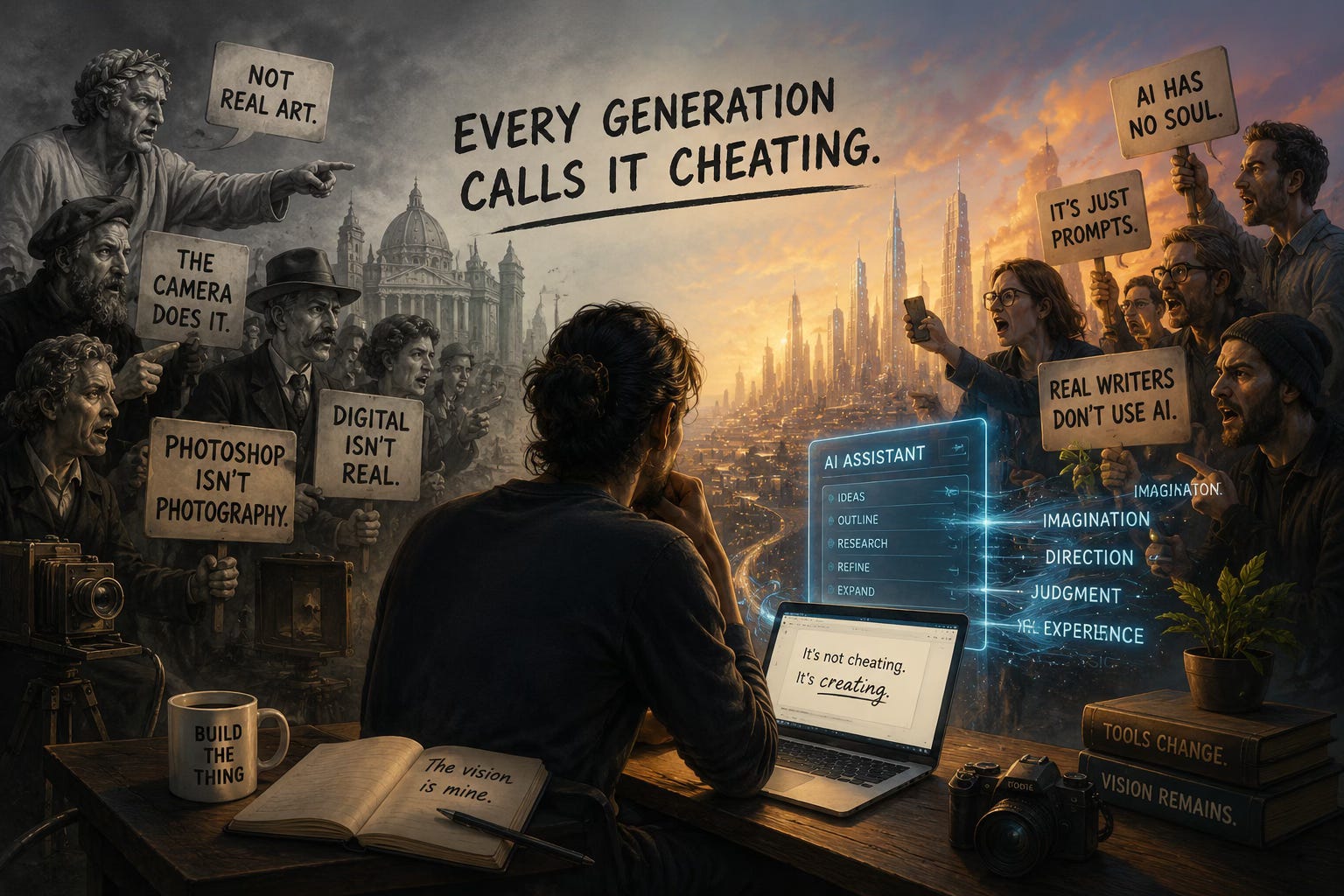
Every generation has a favorite way to say the same thing.
It’s cheating.
The printing press was cheating.
Photography was cheating.
Digital cameras were cheating.
Photoshop was cheating.
And now, apparently, AI-assisted writing is cheating.
Give humanity a new creative tool and someone will immediately stand up, point at it, and declare that this is where real art ends.
They have been wrong for centuries.
If you spend any time on Substack, in writing communities, or just wandering into the general chaos of the internet with a cup of coffee and too much optimism, you have seen the AI witch hunt in full swing. The breathless declarations and the comment section pile-ons. The passionate manifestos from people who have apparently decided that their most urgent creative calling is policing how other people make things.
Writers are being publicly torn apart for a tool they used and it is loud and relentless. And it is, frankly, one of the most historically illiterate arguments happening on the internet right now.
Because none of this is new, not even a little.
Every single time a new creative tool has arrived in human history, someone has stood up, pointed at it with great moral authority, and declared that this — this, right here — is where real art ends. They were wrong every time and they are wrong now.
The receipts go back centuries, and to see the future, one must look to the past.
The Renaissance Survived Without a Comment Section
By 1515, Raphael had assembled what was probably the largest painting workshop ever put together. Reports place fifty artists accompanying him to the Vatican each day — some apprentices, some fully mature artists functioning as partners. Raphael set the vision for every project and designed the compositions. He directed the execution, and oversaw the result. He did not personally paint every inch of every canvas, and under the guild rules of his time, he didn’t need to. A master’s signature meant the work met his standards and reflected his vision. It did not mean his hand had touched every surface— authorship was about the vision.
It was always the vision.
This wasn’t a secret or a scandal. It was simply how art got made — the same way a CEO builds a company. They have an idea for something that doesn’t exist yet. They assemble a team, the team uses tools, and those tools bring the vision into the world. Nobody storms the boardroom to inform the founder that the company isn’t really theirs because Sally drew the blueprint. The vision was theirs, the leadership was theirs, and the direction was theirs. The decisions about what the vision would be and what it wouldn’t — entirely, unmistakably theirs.
Raphael. Da Vinci. Rubens. Every major Renaissance master operated this way. The name on the work belonged to the person with the vision. That understanding held for five centuries without anyone requiring a Twitter thread to explain it.
The Renaissance didn’t have a comment section and the work survived anyway.
Ghostwriting Built the Industry That Now Wants to Draw the Line
While we’re doing historical housekeeping, let’s talk about the publishing industry’s favorite open secret.
Ghostwriting— and I have written about this before. You can read it here.
Estimates from inside the industry place somewhere between fifty and ninety percent of nonfiction bestsellers as ghostwritten or heavily co-written. That celebrity memoir you bought at the airport — in all likelihood, a professional writer shaped every sentence of it. That business book by the thought leader you admire — the odds are not in their favor. The influencer novel, the politician’s autobiography, the titan of industry sharing hard-won wisdom — the ghost economy built the shelves those books are sitting on.
And nobody is in the comments screaming about it. Nobody is writing impassioned notes about the inauthenticity of a memoir that was voiced into a recorder and handed to a craftsperson to shape into something readable. Nobody calls the author a prompter and nobody questions their vision or their voice or their right to claim the work.
Because the ghost is invisible and the assistance is hidden. And if we’re being honest, the argument stripped down to its bones is simply: “A robot helped.”
Which is funny, because most people aren’t actually interacting with a robot, they’re interacting with a language model that arranges words. The same computer they’re typing on is packed with automation. The cell phone, the car, the camera, the computer, the search engine— all robots, all machines, all things we happily accept as machine assistance everywhere in life. But when the machine starts helping with language—the thing we consider uniquely human—the discomfort suddenly becomes visible.
Photography Already Fought This War and Lost
When photography arrived in 1839, painters were dismissive from day one. Critics argued for decades that photography couldn’t qualify as real art because it lacked — and I’m quoting the actual period criticism here — “something beyond mere mechanism.” A machine available to anyone, they said, could not produce what a trained painter’s eye and hand could produce. The outrage was passionate, the moral authority was absolute, and the photographers of the time quietly kept shooting anyway.
I started in photography in the 90’s when it was film. I remember getting my first digital camera and I remember the arguments back then— photographers I knew who had spent years mastering their craft, treating digital like it was a personal insult to everything they’d built. And I understood the feeling because film required a particular kind of discipline. You couldn’t see what you were shooting until it was developed. You had your aperture, your shutter speed, your light meter, different lenses, limited number of images per roll of film and then the processing of film in the dark room— that was the palette. Every shot had weight because every shot cost something.
But here’s what those photographers refused to see: digital didn’t shrink the palette, it exploded it. Manual shooting on a modern digital camera gives you over a hundred ways to manipulate light — exposure, ISO, white balance, shutter speed, aperture, color profiles, sensor characteristics, the way different camera bodies render shadow and highlight. It is a more demanding creative instrument than film was in many ways, not a lesser one. The photographers who resisted digital the hardest are not remembered as the guardians of something pure. They’re just the ones who got left behind while everyone else kept making images.
And then came Photoshop — and the whole argument started over again.
Photographers who had accepted digital drew a new line in the sand. Photoshop was cheating and manipulation. It was an insult to the craft of capturing what was actually there. Some purist photographers didn’t use it. That conversation got loud and stayed loud for years — until it didn’t, because Photoshop became so embedded in the industry that the argument simply ran out of air. Now those same tools live inside your camera, inside Instagram, inside the free app you downloaded on your phone last Tuesday. The thing that was going to destroy photography became the thing photography runs on. Nobody calls it cheating anymore. Nobody calls it anything. It’s just editing and now industry standard.
Today, the retouching I do with AI assistance produces results in seconds that would have taken hours of manual work a few years ago. Even with this tool, my eye is in every frame and my vision shapes every edit. I am not less of a photographer because my tools got better and the argument that I’m less because I do is the exact same argument that was made about Photoshop over a decade ago and about digital in 2004, and about photography itself in 1839.
Same argument every time, different tool. Same people standing at the edge of the wave insisting it won’t reach them.
It always reaches them.
But What About the Water?
Ah yes, the water argument. The one that started appearing in AI criticism once the art theft argument got complicated and the “it has no soul” argument got philosophically awkward.
Data centers do use significant amounts of water for cooling — large facilities can consume up to five million gallons per day, and that is a real infrastructure challenge worth real conversation. The concern about water-stressed regions is legitimate, and the lack of transparency from tech companies about their usage is a fair criticism.
But let’s be precise about what that argument is and what it isn’t.
It’s worth remembering what these data centers are actually powering.
They are not giant warehouses built exclusively so fantasy authors can ask ChatGPT to help fix a paragraph. The same infrastructure supports cloud storage, video streaming, online banking, credit card transactions, email, search engines, GPS navigation, social media feeds, video calls, online shopping, cybersecurity systems, scientific research, weather forecasting, logistics networks, emergency response systems, hospital record systems, medical imaging analysis, pharmaceutical research, fraud detection, language translation, recommendation algorithms, smart home devices, autonomous vehicle development, content moderation, internet search, business analytics, and much of the modern internet itself.
The AI systems people criticize today are also being used to identify cancers in medical scans, detect diabetic retinopathy before patients lose vision, optimize power grids, accelerate drug discovery, improve accessibility for people with disabilities, translate languages in real time, assist customer service teams, analyze cybersecurity threats, and help researchers process data sets too large for humans to review alone.
In other words, when someone points at a data center and says, “That uses water,” they are not pointing at AI-assisted writing. They are pointing at the infrastructure behind a significant portion of modern digital life.
If we want a serious conversation about the environmental costs of that infrastructure, we should absolutely have one. But pretending the entire burden exists because a novelist used AI to brainstorm chapter titles is like blaming a single Netflix viewer for the existence of the electrical grid.
It isn’t an argument against AI-assisted writing. It is an infrastructure and regulatory argument about where data centers are built and how they are cooled — a conversation that belongs between tech companies, municipalities, and policymakers. When someone uses it in a Substack comment to dismiss a writer’s creative work, they have taken a genuine environmental concern and turned it into a rhetorical weapon aimed at the wrong target.
And the technology is already moving.
Closed-loop cooling systems can reduce freshwater use by up to seventy percent. Immersion cooling — submerging servers in non-conductive fluid — removes heat without evaporating water at all. Google and Microsoft have both committed to being water positive by 2030. The same innovation curve that drove AI capability is now being applied to AI’s resource footprint, because that’s what happens when a problem gets big enough to be worth solving.
The people wielding the water argument against individual writers using AI tools are not environmentalists. They’re reaching. And they will need a new reach soon.
AI slop
First, let’s acknowledge that AI slop absolutely exists. So do bad books, bad movies, bad paintings, bad photographs, bad songs, and bad opinions posted with tremendous confidence on the internet. The existence of low-quality work is not a revolutionary discovery and humanity has been producing slop since the invention of humanity.
What fascinates me is the people who can spot AI from three counties away.
They’ll confidently identify a suspicious phrase, a familiar cadence, an overused transition, or a sentence structure they believe gives the machine away, and sometimes they’re right. But to develop that level of pattern recognition, you generally need exposure to the pattern in the first place.
So in reality a significant number of the people writing the most passionate anti-AI articles have used AI. Maybe not to write the piece — but to research it or to summarize sources, or to draft an email, generate a caption, ask a question they didn’t want to Google at two in the morning. The tools are so woven into daily life that most people interact with AI multiple times before lunch without noticing. The reason so many critics can identify AI writing patterns so confidently is because they have spent enough time inside these tools to recognize the output. They’ve studied the fingerprints, memorized the speech patterns, and trained themselves to identify the tells. They have, in many cases, become specialists in the very thing they claim to despise.
The irony.
It’s a strange position to occupy. Imagine dedicating years to proving a restaurant serves terrible food, only to discover you’ve become the person who’s eaten there more than anyone else.
The average reader isn’t conducting a forensic investigation while reading an article. They’re asking a much simpler question: Was this useful? Was it entertaining? Did it make me think? Most readers do not arrive carrying a magnifying glass and a warrant.
I’m not saying everyone, but the people most determined to hunt for AI are often the people who have spent the most time staring directly at it in one way or another.
Tools
Back in the ’90s, Swiss Army knives were everywhere. They were bulky, bright red, and somehow every boy who owned one felt obligated to show you all seventeen attachments whether you asked or not.
The funny thing is that nobody judged how you used it. If you needed scissors, you flipped out the tiny little scissors. If you needed a screwdriver, you used the screwdriver. If you needed a knife, you used the knife. Nobody stood there insisting that real scissors users should carry dedicated scissors, forged by a master craftsman, and stored in a velvet-lined case.
Sure, the scissors were ridiculous. They were small, awkward, and attached to a pocketknife. But if someone needed to cut a loose thread, they got the job done. In fact, the person carrying the Swiss Army knife was usually the hero of the moment because they had the tool when the situation called for it.
A tool is a tool. People use them in different ways. And for most of human history, we’ve judged tools by whether they solved a problem—not by whether they were the purest possible version of themselves.
The Virtue of Doing It the Hard Way
When performance is difficult, effort can become identity.
Think about coffee for a second. Imagine someone who grew their own beans, harvested them by hand, roasted them over a fire they made with two sticks they found in the yard, ground them down with a rock from the driveway, and brewed the whole thing over an open flame at five in the morning.
Impressive commitment. Genuinely. But does that make their coffee better than the cup coming out of the machine on your countertop? And more importantly — does it make them a better person for having done it the hard way? The answer is no, and anyone who tells you otherwise is not actually talking about coffee.
Suffering doesn’t improve the coffee.
They’re talking about virtue and identity. They’re talking about the quiet belief that effort itself creates value.
We do this everywhere. The cyclist judges the driver. The manual laborer looks at the office worker. The painter looks at the photographer. The photographer looks at the AI artist. The writer looks at the writer using AI.
Somewhere along the way, we stopped asking whether the tool was useful and started asking whether the struggle was sufficiently painful.
But difficulty is not a moral achievement.
If someone rides a bike because they enjoy it, wonderful. If someone drives because they need to get across town in ten minutes, also wonderful. The bike is not virtuous and the car is not lazy. They are tools solving different problems for different people.
The same is true of creative tools. The value of the work isn’t measured by how many obstacles you refused to remove. It’s measured by what you ultimately created.
Because the question was never whether a tool makes something easier.
The question is whether the tool helps you create something worth making.
Where This Is All Going Whether They Like It or Not
ChatGPT alone has roughly 900 million active users. One in eight people on this planet, and it has been widely available for just three years. The trajectory is not toward less adoption, it’s toward more, faster, woven deeper into every form of creative and professional work that exists.
The generation stepping into adulthood right now grew up with these tools. They are not going to arrive at the keyboard carrying the same resistance that some people carry today, because for them AI assistance will simply be part of how things get made — the way spell check is, the way autocorrect is, the way Photoshop filters are now. Every tool that once felt like cheating eventually just becomes the baseline. They will be writing the laws and setting the cultural norms and deciding what authorship means in the world they actually live in.
So let’s be honest about what the argument actually is. It was never really about whether AI should exist. It was about whether you should be allowed to use it openly, without apology, without a disclaimer, without performing sufficient guilt to satisfy the room. That is a very different conversation—and one that often reveals far more about the discomforts, assumptions, and beliefs of the person making the accusation than the person receiving it.
AI Copyrights
The current copyright restrictions around AI-assisted work exist largely because the opposition has been loud enough to force a legislative response, but you cannot pass a law that stops a wave. The tool is too embedded, used by too many people, too genuinely useful for the noise to hold.
By 2035 you will be able to copyright AI-assisted writing without this conversation needing to happen around it. I’d put money on it. I live in Vegas. We bet on things here.
The people writing the most passionate arguments against AI writing right now do not have a clear vision for where this is going. They are looking backward, trying to hold a line the future already crossed.
This Part Is for You
You know who you are.
STOP. Stop explaining yourself.
Stop announcing your tools. Stop defending your process and oversharing. Stop feeling obligated to provide a detailed accounting of every piece of software, every workflow, every shortcut, and every creative decision as though you’re standing before a committee asking for permission to make art.
You do not need permission.
You do not need to justify how you brainstorm, how you outline, how you edit, how you research, or how you get unstuck. You do not need to convince strangers on the internet that your process meets their personal standards for creative purity.
You are creating something.
You’re writing the story that has been living inside you and you’re building the world you cannot stop thinking about. You are trying to get an idea out of your head and into reality using whatever combination of tools, experience, skill, stubbornness, and late-night determination actually works for your life.
And if somewhere in the back of your mind there is a voice telling you that it doesn’t fully count, that you’re somehow cheating, that you need one more disclaimer before you’re allowed to call yourself a writer—
That voice is lying to you.
And here’s something the loudest critics will never say out loud: the person using AI assistance to build a vision is not a prompter. Calling someone a prompter is the new version of calling a photographer someone who just pushes a button — it’s a taunt designed to reduce what you’re doing to its most mechanical description and ignore everything else. You are not a prompter. You are the CEO of your vision and you are building it. You are the founder, the creative director, the person with the vision and the judgment to shape it into something real.
The vision you brought to the page is yours. The direction you gave the language, the details you kept and the ones you cut, the emotional truth you insisted on even when the draft wanted to go somewhere easier — that is yours. No tool generates that and no tool decides what matters. No tool knows what you know, or has lived what you’ve lived, or cares the way you care about the specific vision you are trying to create and put into language.
At the end of the day, every argument against AI-assisted writing is just another version of the same thing: I did it the hard way, so my way is the right way. You’re a better person because you rode your bike to work. You’re a more legitimate writer because you typed every word at four in the morning before your shift. But a writer is not a method— a writer is a human being who has lived something, metabolized it, and found a way to hand that experience to another person through words. If the reader receives it — if they feel something, recognize something, carry something away from the page — then the vision worked.
That’s the whole point. That has always been the whole point. Nobody finishes a book and thinks about how it was made, they think about how it made them feel.
So, you are not getting away with something, you are doing exactly what every builder, every master with a studio full of hands, every founder and CEO with a team of engineers has always done — directing a vision into existence with the best tools available.
The work is yours, so please stop whispering about it and put it out there.
Use every tool available to you and build the vision you came here to build. The readers meant to find it will find it, the community meant to gather will gather, and the people in the comments arguing about how it was made will still be there arguing long after you’ve moved on to the next one.
That’s the difference between building and performing.
So build the vision.
Postscript: Why This Is My Last AI Rant
The title of this essay is Every Generation Calls It Cheating.
And that’s exactly why this will probably be the last time I write about it because the argument is already aging faster than the technology.
Every month there is more AI in the world, not less. More people using it, more businesses depending on it, more writers experimenting with it, more students growing up with it and more tools quietly integrating it until nobody thinks to mention it anymore.
The witch hunts are already getting harder to sustain because the line between “AI users” and “non-AI users” becomes blurrier every day. The people condemning it use AI-powered search, AI-powered recommendations, AI-powered editing, AI-powered cameras, AI-powered spam filters, AI-powered navigation, AI-powered customer service. AI-powered everything.
Eventually this argument will go the way of the photography argument, the Photoshop argument, the digital camera argument, and every other argument that started with “this isn’t real” and ended with “this is normal.”
A year from now, maybe less, large parts of this essay will feel outdated because the culture will have moved on to whatever new thing we’re supposed to be afraid of.
And honestly?
Good.
I would much rather spend my time writing stories than defending the existence of a tool.
So if this essay ages poorly, I will consider that a victory.
It means the future arrived.
Hi, I’m Elle Abbott, and thank you for spending part of your day with me. Whether you agreed with every word, argued with half of it, or found yourself somewhere in the messy middle, I hope this article gave you something worth thinking about.
More than anything, I hope it encouraged a few creators to stop apologizing and start building.
If you’d like to stick around, I’d love to have you. Most days I’m not ranting about AI, I’m writing fantasy, romantasy, painfully slow-burn romance, ridiculous parody, and the occasional emotional catastrophe disguised as fiction.
Subscribe if you enjoy laughing, feeling things you weren’t emotionally prepared to feel, or spending time with people who take storytelling seriously but themselves a little less so.
Welcome to The Warden’s Archive.
“The writer looks at the writer using AI.”
Imagine a person who read voraciously as a child, then as a teen, a young adult, who tries their hand at writing. Then grows more serous and takes classes in literature and writing. Then spends years coming up with his own ideas for stories, poems, novels, and attends writing seminars, joins book clubs and analyzes novels with others. At some point this person decides to ‘try to publish.’ He labors for a couple years over a book. Workshops it, decides which criticisms to embrace, which to disregard. He or she is the decider, the writer. At some point he manages to sell that work, that novel, and is successful. The book is appreciated, warmly recognized, but is not a bestseller. He writes another and gets the same result. Resigned to not being a best-selling author, he continues to write, spends a lifetime doing that.
Then there’s the other guy, the ‘writer using AI.’ Maybe he’s just a lazy schlub that never composed a poem or short story, let alone a novel. Maybe he never read a book. He used CliffsNotes, taking the analysis and quotes, and putting them in his book report or paper and put ‘his’ name as the author. Then he gets the notion that writing and publishing a book gives one prestige. Women might be more interested in him if he’s a writer, and achiever, a serious, skilled wordsmith.
But he’s never written anything nor wanted to, too much work involved. Then AI comes along and he finds out that he can tell it what he wants it to write, then sit back and wait… a few minutes, maybe an hour.
“That’s good,” he says, “but I’d rather the hero be left-handed.”
“Yes, master,” the AI says. Then goes off to make that and a few other changes.
Then, our schlub puts his name on it and has it published. His ‘efforts’ are lauded, he is compared to the writer(s) who actually worked on their book for years. And over the months and years, the schlub has thousands, then millions more ‘competitors’ who want to ‘write’ a book as well, and do, using AI (or AI does it.).
The real writer(s)’ work is lost in the flood of dross that is published. There’s so much being published that 99.9% of it cannot be vetted. The good and admirable is swallowed up by the bad and the ugly.
One other point. You keep emphasizing that AI is a tool.
If you wanted to dig a swimming pool without spending months digging it out with a shovel, you would buy a ‘tool,’ one better than a shovel, a tractor. But you cannot tell your tractor to dig your pool. You have to use the tractor.
There are scientists around the world attempting to create autonomous robots (machines with AI intelligence). I believe they are semi-autonomous at this point. When they become (and scientists believe they will) autonomous and sentient, then they ARE NO LONGER TOOLS. They, if they do our bidding, are more like shiny metallic slaves powered by electrical current instead of flesh and blood.
When man creates his own god, for how long would that god do his bidding.
Kaboom 💥
Thanks, Warden!
Great article. Artists especially feel threatened by AI 🤖 when it’s just another tool, that’s been being developed since the days of DaVinci!
What if Michelangelo was required to use finger-paints because “using a brush is cheating?!” 🖌️
Creative content comes from artists.
A rendering tool is like a rock tumbler… it just polishes what already exists.
Go get em, Warden. 😊✌️